
As a guide, retaining wall cost in Adelaide is about $650 to $1,150 per square metre of wall face, including GST. Most of that difference comes from the material. For a straight wall 10 metres long and 1 metre high, that's around $6,500 in concrete sleepers, $7,500 in concrete retaining block, or $11,500 in dry-laid stone.
Those figures are for a wall about 1 metre high on a site with reasonable access. Every wall is still quoted on its own, because height, access and digging can move the price a long way. The rest of this guide covers what moves it, using walls we've built.
Retaining Wall Cost per Square Metre
The per square metre figures come from that same wall, 10 metres long and 1 metre high, which has 10 square metres of face. Use them as a starting point, not a calculator: a lower wall still needs a footing and drainage along its full length, so it won't come in at a simple fraction of the price.
| Material | 10 m long, 1 m high | Per m² of wall face |
|---|---|---|
| Concrete sleepers | about $6,500 | about $650 |
| Concrete retaining block | about $7,500 | about $750 |
| Dry-laid stone | about $11,500 | about $1,150 |
| All figures include GST, as at October 2026. | ||
Sleepers, Block or Stone
Concrete sleepers are the cheapest of the three. The sleepers slot between steel posts set in concrete, and they suit a straight run of wall. They don't have to look plain: in Craigburn Farm, two tiers of stone-textured sleepers between galvanised posts step the garden up from the lawn to the pool, with the glass pool fence along the top. Those walls sit on fill, so even though they're only about a metre high, the steel posts go 2.4 metres into the ground in concrete.
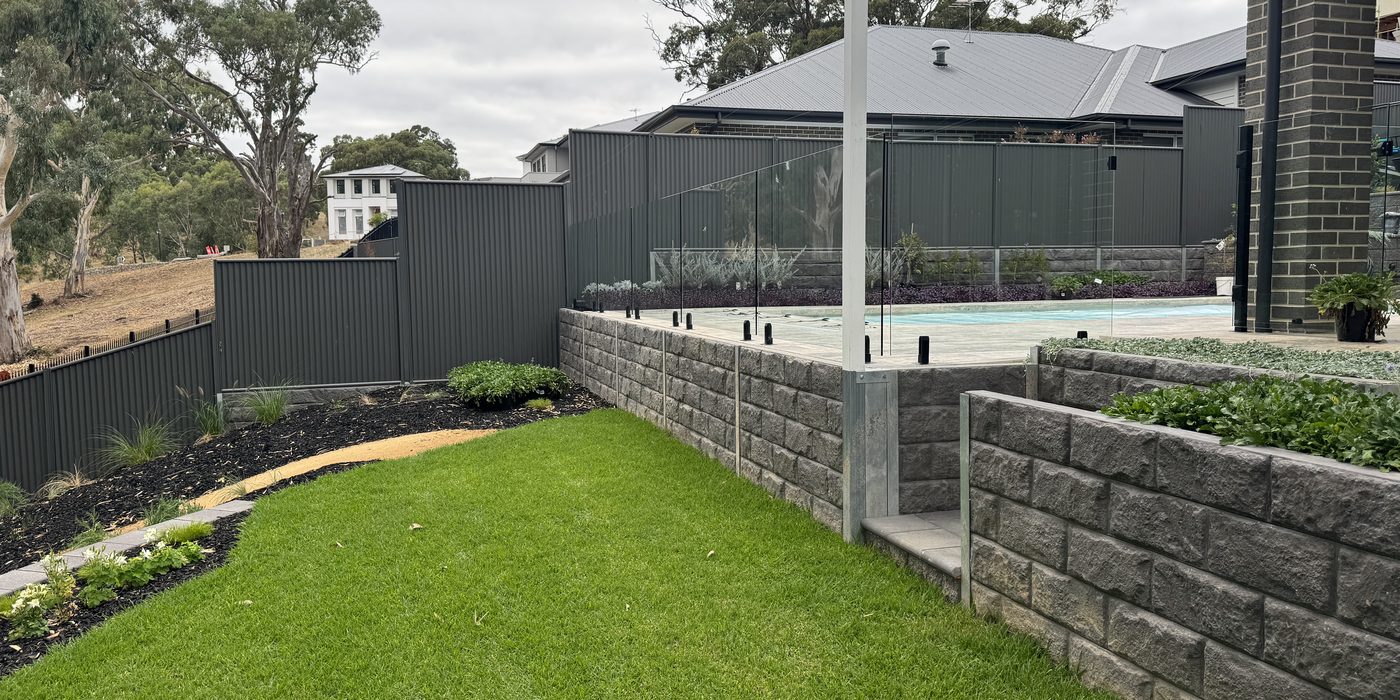
Concrete retaining block costs a little more and gives a more formal finish, with matching caps. On a steep Glen Osmond block we used charcoal concrete retaining blocks with split face caps, for the wall and for the steps up to the deck. On the same Craigburn Farm job, the curved wall lower in the garden is block, finished with a bullnose coping.
Natural stone costs the most, because every stone is placed by hand. At a Willunga South winery, Basket Range sandstone was dry-stacked on concrete footings for a circular feature wall, then waterproofed with a membrane so water couldn't seep into the stone. If you like the look of stone but not the price, a textured concrete block gets close to it for less.
What Pushes the Price Up
- Height over 1 metre. A wall retaining more than 1 metre of ground, or one closer than 1 metre to a boundary, generally needs Development Approval from your council, and a taller wall usually needs an engineer's design with a stronger footing and reinforcement. On a second Glen Osmond job, an infinity-edge pool renovation, the feature walls down by the road were Besser block on a reinforced concrete footing with starter bars, then core-filled with concrete. A low garden-bed wall needs none of that.
- Access. If a machine can't get in, soil and materials move by hand or with smaller gear, and that takes longer. On the Glen Osmond deck job the neighbours agreed to a path up to the backyard, so a tracked dumper and an excavator could take out about 25 tonnes of dirt and rock and bring in the blocks, the rubble for the base and 20 tonnes of washed sand.
- Digging and soil removal. Cutting into a slope makes spoil, and it has to go somewhere. If it can't be spread on site, it's carted away and the tip fees go into the price. Our small earthworks page covers that side of the job.
- Finishes. Caps, render and paint all add to the cost. The walls beside the Glen Osmond pool spillway were rendered with Dulux Acratex, then painted.
Don't Save Money on Drainage
Water building up behind a wall is the biggest single cause of retaining wall failure. It adds pressure the wall wasn't designed to hold, and over time the wall leans or comes down. A wall that has failed usually has to be pulled down and rebuilt, which costs far more than draining it properly the first time.
On the Glen Osmond wall, the footing was a 150mm deep compacted rubble base, levelled with a sand and cement screed. The voids between the blocks were filled with 14mm gravel, and plastic, geofabric and a slot drain went in behind the wall before it was backfilled. That's the part of a quote to keep when you're looking for savings.
Keeping the Cost Down
- Keep walls to 1 metre or less where the levels allow, and at least 1 metre off the boundary. That generally avoids council approval and the engineering that comes with a taller wall.
- Choose block instead of stone if the budget matters more than a natural look.
- Get the drainage priced in from the start, rather than added once the wall is up.
For how we build a wall, from the footing to the drainage, see our retaining walls page.
Retaining Wall Cost FAQ
How much does a retaining wall cost per square metre?
As a guide, about $650 per square metre of wall face for concrete sleepers, $750 for concrete retaining block and $1,150 for dry-laid stone, including GST, for a wall about 1 metre high. A taller wall, a hard-to-reach site or a lot of digging pushes the price up.
Is a sleeper retaining wall cheaper than a block wall?
Yes. For a wall 10 metres long and 1 metre high, concrete sleepers come to around $6,500 and concrete retaining block around $7,500, including GST. Block costs a little more but suits a more formal look, and it comes with matching caps.
Why does a retaining wall over 1 metre cost more?
A wall retaining more than 1 metre of ground generally needs Development Approval from your council and usually an engineer's design, with a stronger footing and reinforcement. We tell you upfront whether your wall needs it.
Does drainage add to the cost of a retaining wall?
It adds some cost, and it's the part we won't cut. Gravel, geofabric and a drain behind the wall give water somewhere to go. Without them, water pressure builds up behind the wall, which is the biggest single cause of retaining wall failure.
How do I get an exact price for my retaining wall?
Book a site consultation. We look at the length and height of the wall, the access and the drainage on site, then give you a written quote.
General information only. Every site is different, so get advice for yours before you start work. Prices are a guide only, as at the date published. See our disclaimer.
Got a slope that needs a wall? Tell us what you have in mind.
Book a Site Consultation