
A small courtyard or side garden gets thought through differently to a driveway or a big open patio. The same paver, pattern or colour choice that works fine across 60 square metres can either make a tight space feel considered and generous, or noticeably smaller and busier. These are the real decisions worth getting right before paving starts, not after.
Paver Size
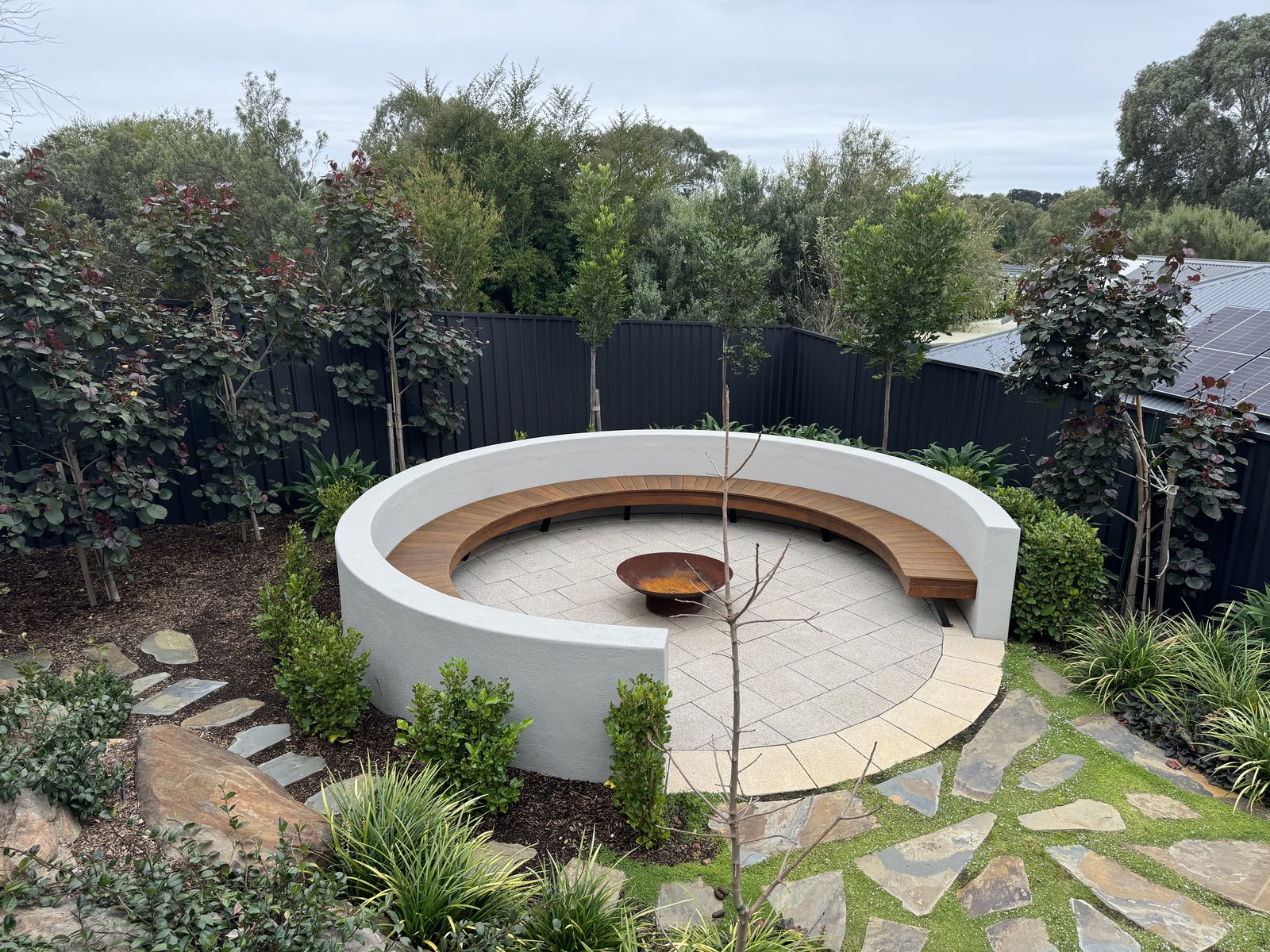
Larger format pavers generally suit a small space better than small ones. Fewer joints across a limited area reads as calmer and visually stretches the space, where a lot of small pavers and the grout lines between them can make the same courtyard feel busier and, counterintuitively, smaller. The radial paving in the firepit courtyard pictured above uses this exact principle: large, simple segments rather than a fussy small-unit pattern, so the circular shape reads clearly instead of getting lost in detail.
Colour
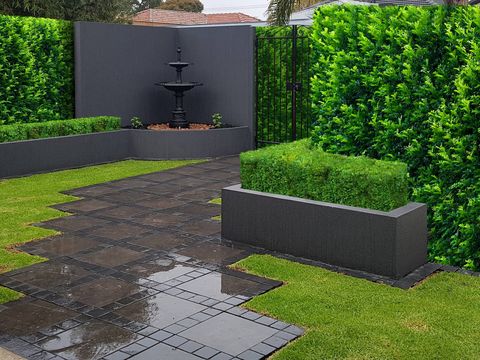
A shaded, enclosed courtyard generally benefits from lighter paving to help bounce available light around rather than absorb it, especially where surrounding walls or fencing block a lot of direct sun. That said, dark paving can look genuinely striking in the right setting: a dark charcoal grid-pattern paver set into lawn, as in a Glenelg North courtyard we built, reads as considered and sophisticated specifically because it's offset against green hedging and lawn rather than more dark surfaces. Dark paving in a small, all-hardscape courtyard with no green relief tends to feel heavier and hotter than the same colour used with planting to break it up.
Pattern
Pattern choice matters more, not less, at a small scale, since there's less area for a busy pattern to resolve into before you hit the edge of the space. A simple stack bond or large-format stretcher bond generally reads calmest in a small square or rectangular courtyard; herringbone and other diagonal patterns can help visually stretch a narrow, elongated courtyard along its length, the same way it's used to strengthen a driveway (see our paving installation page for the mechanics of why herringbone locks together the way it does). A circular or curved courtyard, like the firepit example above, often suits a radial or curved-course pattern that follows the actual shape rather than fighting it with straight lines.
Indoor-Outdoor Flow
Matching or closely coordinating a courtyard's paving with adjacent indoor flooring, or at minimum keeping the finished paving height close to an internal floor level at a doorway, makes a small courtyard read as an extension of the house rather than a separate outdoor add-on. This matters proportionally more in a small courtyard than a large backyard, since there's less distance between the door and the far wall for the transition to feel gradual.
Drainage
A small courtyard enclosed by walls or fencing on two, three or all four sides needs more careful drainage planning than an open garden area, not less: there's often nowhere for water to naturally run off into lawn or garden beds the way it can in a more open layout. Falls need to be built into the base during installation, directing water to a proper drainage point (a grated drain, a gap to an adjoining garden bed, or a connection into the stormwater system), worked out before the first paver goes down rather than discovered the first time it rains hard.
Features and Lighting
A small courtyard is exactly where a focal point earns its keep: a firepit, as in the Aberfoyle Park example above (see our garden features page for how that's built), or a water feature, gives the eye somewhere to land in a space too small for the layered "walk around and discover it" approach a bigger garden allows. The same goes for garden lighting: a small courtyard tends to get used at night for entertaining more often, proportionally, than a large backyard, so it's worth getting the lighting right rather than treating it as an afterthought.
Quick tips for a small courtyard:
- Paver size: go larger format, not smaller. Fewer joints reads as calmer and visually stretches the space.
- Colour: lighter paving bounces light around a shaded, enclosed courtyard; dark paving works best offset against lawn or planting.
- Pattern: simple stack or stretcher bond suits a small square courtyard; herringbone stretches a narrow one; radial or curved courses suit a circular space.
- Indoor-outdoor flow: keep finished paving height close to the internal floor level at the doorway.
- Drainage: plan falls into the base before the first paver goes down. An enclosed courtyard has fewer natural run-off points than an open garden.
- Features and lighting: a firepit or water feature gives a small space a focal point, and lighting matters more since courtyards get used at night more often.
Small Courtyard Paving FAQ
What size paver suits a small courtyard?
Larger format pavers, generally. Fewer joints across a small area reads as calmer and makes the space feel bigger, where lots of small pavers and grout lines can visually shrink it. There are exceptions where a smaller unit and busier pattern is exactly the look wanted, but it's a deliberate choice, not a default.
Does a small courtyard cost less to pave than a driveway?
Usually less in total simply because there's less area, but the cost per square metre can be similar or higher. A small, enclosed courtyard often has worse machine access than an open driveway, and higher-end materials are more common in a feature entertaining space than a driveway.
Does a paved courtyard need drainage falls?
Yes: arguably more carefully than an open garden area, since a courtyard enclosed by walls or fencing on multiple sides can't rely on water simply running off into lawn or garden beds. Falls need to be planned toward a proper drainage point before paving starts, not worked out afterwards.
Can a small courtyard be paved without professional help?
The area being small doesn't make the base preparation and drainage any less critical: a poorly prepared small job fails the same way a poorly prepared large one does, just sooner, since a courtyard sees concentrated foot traffic in a tight space.
What goes well with paving in a small courtyard?
A firepit or water feature as a focal point, low-voltage lighting to actually use the space at night, and planting around the edges rather than in the middle. All three are common additions once the hard surface itself is down.
See our full paving installation page for the process, or our sandstone versus concrete pavers comparison if you're still choosing a material.
General information only. Every site is different, so get advice for yours before you start work. Prices are a guide only, as at the date published. See our disclaimer.
Planning a courtyard or small garden area? Tell us what you have in mind and we'll help you get the paving right.
Book a Site Consultation