
A hardwood deck needs a penetrating decking oil, not paint or varnish. Getting this wrong is one of the most common mistakes made on a timber deck, and it's an expensive one, because a coating that fails has to be stripped right back before the deck can be done properly.
Spring is a good time to think about it. A deck that goes into an Adelaide summer with no protection takes the full force of the sun, and that's when the boards start to grey, dry out and check.
Why Decking Oil, Not Paint or Varnish
Paint and varnish are film-forming finishes. They sit on top of the timber as a skin. Hardwood decking doesn't sit still: it swells when it's wet and shrinks as it dries and heats up, every season. A film on top can't move with it, so it cracks and peels, and once that starts the only real fix is sanding the whole lot back and starting again.
Deck oil works differently. It soaks into the timber and protects it from within, so the boards can still move without anything on top to crack. It also protects against UV and rain, resists marks from foot traffic, leaves and dirt, and most oils give some protection against mould and algae as a side benefit.
Oil or Stain?
This is the question people ask most, and the answer depends on the colour you want, not the protection.
- Clear oil. If you're happy with the colour of the timber and just want to stop it turning grey, a clear oil does the job. It's translucent, so it doesn't change the colour. It gives the boards a slightly wet look that brings out the grain.
- Tinted oil. If you'd like the timber a bit warmer or richer, a tint or stain in the oil does that, with the same penetrating protection underneath.
Tinted oils are sold to suit each species. On a Merbau deck we use a Merbau-tinted oil, because it keeps the reddish-brown even across the boards. Jarrah, Spotted Gum and Blackbutt each have their own colour, so pick a clear oil or a tint made for that timber. See our hardwood vs composite decking guide for how the four species compare.
How We Oil a New Deck: Glen Osmond
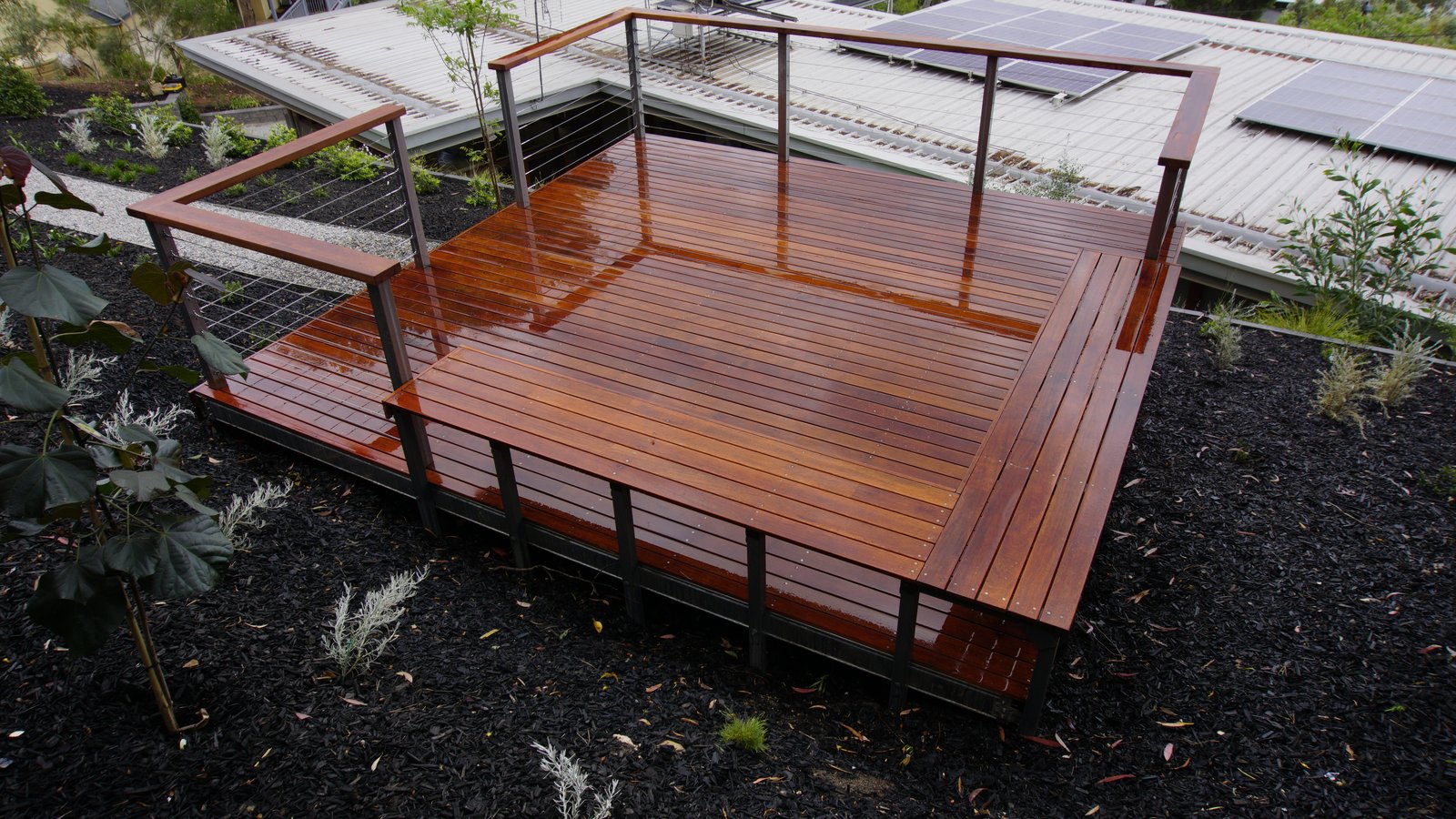
On the Glen Osmond deck, a steel-framed deck on a steep, rocky block, we used pre-oiled 90mm x 18mm Merbau boards, fixed to the steel frame with stainless steel screws. Once the deck, built-in seating and Merbau balustrade were finished, the whole lot was sanded to 120 grit and given two coats of a quality matt timber oil before handover.
That last step is easy to skip, and it's the one that stops the sun, wind and rain greying and cracking new timber early. That's why every timber deck we quote includes two coats of oil in the price. Composite decks don't get this line, because they don't need it.
When to Re-oil a Deck
Water is the test. Splash a little on the boards:
- It beads up and sits on top: the oil is still working.
- It soaks straight in: the deck is due for re-oiling.
How long that takes isn't a fixed number. It depends on the timber, your suburb and how exposed the deck is. A deck in full afternoon sun will need it sooner than one under a pergola or shaded by trees. Left too long, the timber turns grey. That's a colour change from UV, not rot, but it means the boards are no longer protected, and they can start to check (small splits along the grain) in hot weather.
Re-oiling an older deck takes more work than oiling a new one. The boards need a proper clean with a deck cleaner first, and any damaged or splintered boards should be repaired or replaced before the oil goes on. Oil over dirt or a rough surface won't go on evenly, and it shows up as streaks. The instructions on the tin make it look easy, but getting an even finish over a whole deck comes from having done it many times.
For the building side, from footings and frames to choosing the boards, see our timber decks page.
Decking Oil FAQ
Can I paint or varnish a timber deck instead of oiling it?
Not if you want it to last. Paint and varnish form a film on top of the timber, and hardwood decking moves as it heats, cools, wets and dries. The film can't move with it, so it cracks and peels, and the only fix is stripping it all back. Deck oil soaks into the timber and protects it from within, so the boards can still move.
Should I use decking oil or stain?
If you like the natural colour of the timber, use a clear decking oil. It protects the boards and gives them a richer, wet look without changing the colour. If you want the timber warmer or darker, use a tinted oil, which gives the same protection with added colour. Avoid anything that sits on the surface like paint.
How do I know when my deck needs re-oiling?
Splash some water on the boards. If it beads up and sits on top, the oil is still working. If it soaks straight in, it's time to re-oil. How long that takes depends on the timber, your suburb and how exposed the deck is to sun and weather.
Does deck oil change the colour of the timber?
A clear oil doesn't change the colour. It brings out the grain and gives the boards a slightly wet look. A tinted oil adds colour on top of the same protection.
Does a composite deck need oiling?
No. Composite boards need an occasional clean but no oil or sealer at all. Only timber decks get oiled.
General information only. Every site is different, so get advice for yours before you start work. Prices are a guide only, as at the date published. See our disclaimer.
Planning a new hardwood deck? Tell us what you have in mind.
Book a Site Consultation